

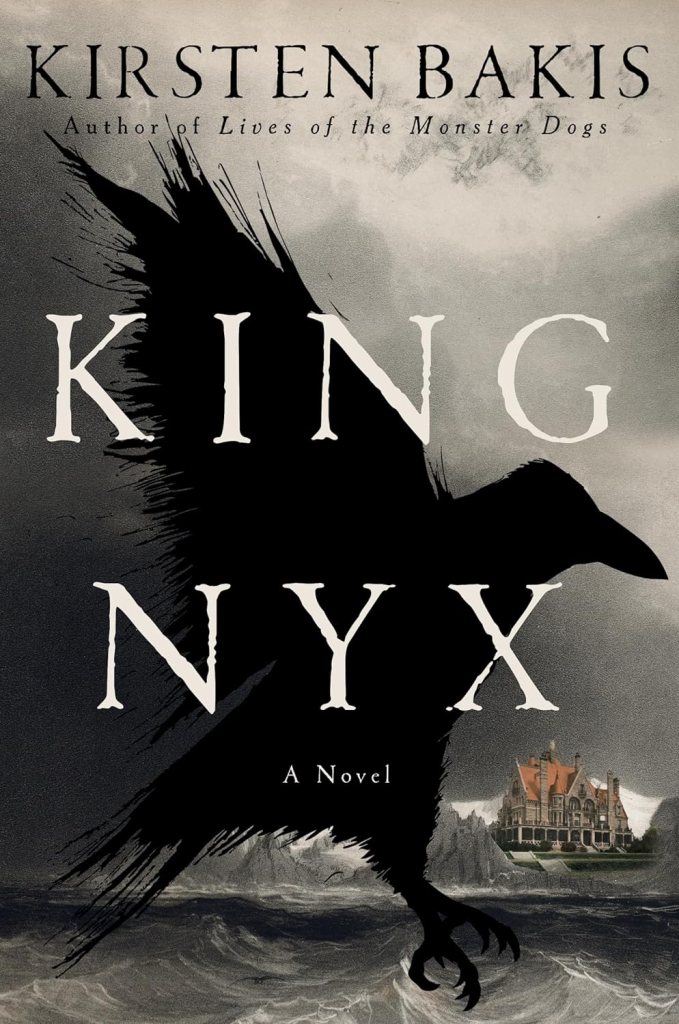
The Speculative Shelf is very excited to welcome Kirsten Bakis to the blog to discuss her brilliant new novel, King Nyx (out now from Liveright Books/Norton).
You can find our review of the book here.
Publisher’s summary:
Anna Fort wants to be a supportive wife, even if that means accompanying her husband for the winter of 1918 to a remote, frozen island estate so he can finish his book as the guest of an eccentric millionaire. When she learns three girls are missing from a school run by their host, Anna realizes finding them is up to her—even if that means risking her husband’s career, and possibly her life.
Q&A with author Kirsten Bakis:
Did you have prior knowledge of the Forts before writing the book? What drew you to them, and Anna Fort, in particular?
KB: I learned about Charles Fort years ago, and he stayed in my mind because he’s such an interesting character. For years, he spent his days in public libraries combing through books and scientific and meteorological journals in search of anomalous events, carefully copying out quotes and citations by hand, and bringing them home to file in a special cataloging system in shoeboxes. He wrote long rambling books putting forth a variety of strange and mismatched theories about why these things happened. For example, he suggested that red rain, or blood rain—which has been recorded in various times and places throughout history—might be caused by gigantic creatures in outer space fighting and bleeding. Sometimes he claimed he wasn’t serious, but his distrust of the scientific establishment and desire to poke holes in its logic (which he didn’t do a very good job of) did seem serious.
So, initially, I thought I would like to write a book about him. But the more I learned about his wife, Anna, the more I began to think that the really interesting story was hers.
A lot of people thought Charles was a crank, but a few—notably the famous novelist Theodore Dreiser—thought he was a genius. As a result, Charles wound up publishing several books and making a name for himself. Today, we have hundreds of pages of his rambling thoughts, and hundreds more of notes by Theodore Dreiser for a never-published biography of Charles. But much less is known about Anna, the woman who made his writing career possible by working backbreaking domestic labor jobs and basically taking care of him in every way—and yet who was pretty silent on the topic of what she thought of his books.
Dreiser, in his notes about a dinner he had with the Forts, dismissed her as being unable to understand her brilliant husband, and characterized her as a woman who “cannot think.”
She had once wanted to be a singer, but gave that up to take a backseat to her husband’s career. I do think the two of them genuinely loved each other, that she wanted him to succeed and that he appreciated her. But I couldn’t stop thinking about what that must have been like for her, and what might have played into her decision to prioritize him and his strange, nonsensical writings, which she herself didn’t seem to buy into. What made her choose to put her own desires on hold so that he could succeed? It’s such a familiar story, such a familiar dynamic. I wanted to examine it.
Since not much is known about Anna Filing Fort, I made up a gothic, extravagant, sort of over-the-top adventure for her—something I wish she could have had, something I wanted to give her retroactively.
The dialogue and language choices really do a great job capturing the distinct tone and feel of the time period. How did you channel that voice?
KB: Thank you. I’m not sure how it works, exactly, but I know I spent a lot of time researching the era, and reading the works of Charles Fort and others who wrote in the early 20th century. Not so much (for this purpose) the great writers with their own precise and distinct voices, like Virginia Woolf, but more ordinary things—chatty magazine articles, interviews, and that kind of thing. But I think most of it really happens when you’re sitting down and writing and just trying to—as you said—channel something. I do think that in some way, that’s what’s happening—you’re opening yourself up to voices that aren’t exactly yours, personalities that are different from your own. I have no idea how that works. It’s something so many writers talk about. I think there may be an element of actual magic.
Was it an intentional choice to tease a big spooky mansion and then put the characters on the outside looking in for most of the book?
KB: That’s a good question! I definitely think of gothic fiction as generally taking place partly inside a big spooky mansion, and King Nyx doesn’t, for most of the book. I want to say that it was a completely intentional and logical choice, but in truth, so much of writing happens by instinct. At some point I realized that they just weren’t going to get into the house until the end. So I decided to work with that.
I do think that it’s a story about people who don’t get to inhabit the mansion—not really. Even if some of them do live in fine houses, they’re servants, or they’re, in some way, not in the center of power, and that fact shapes their lives. They orbit men who are the center, the sun, of their own little universes, and everyone else is just moving carefully around them. That’s part of what I see the story as being about.
What’s a piece of popular media (movie/TV show/book) you could fill in this blank with – “if you like _______ , you’ll like King Nyx.”
KB: This is a hard question! It’s so hard for me to see King Nyx from the outside. Maybe to put it in more general terms: if you like gothic fiction, if you like mystery, if you like feminism, if you like stories about eccentric millionaires, and creepy dolls, and suspense, and . . . talking birds??? — then you’ll like King Nyx.
I read that you haven’t reread your breakout debut, Lives of the Monster Dogs, in the 27 years since it’s been published. Do you think you’ll keep the same distance between yourself and King Nyx now that it’s out in the world?
KB: I think I might! It can be fun to try to translate a book into a really different form, like a screenplay, for example—where you really have to make changes to make it work. So that could be a reason to revisit something. But the idea of just re-reading it again as a novel doesn’t seem interesting to me. I’ve been over every inch of it, every word and comma, so many times, and that was fun, but I feel like it’s time to go onto other things.
What’s the last great book you read?
KB: I’ve been really enjoying Tana French’s novels lately. I especially love her first, In the Woods, which I read a few months ago, and also The Secret Place. She’s so good with suspense, and just a great, accomplished craftsperson—I’ve been taking a lot of notes as I read about what she’s doing and how she’s doing it. I’ve also recently discovered Seishi Yokomizo, a Japanese mystery novelist who published a lot in the mid-20th century. Pushkin Press, in the UK, is publishing English translations of some of them now. I loved The Village of Eight Graves and Death on Gokuman Island. They’re mysteries, but they also have a kind of folk-horror feel to them, which is true of a lot of Tana French’s work as well. A mix of folk horror and mystery is something I just love as a reader. I’m currently reading Victor LaValle’s Lone Women, which is historical horror, and it’s looking like it’s going to be fantastic.
Thank you so much for taking the time to offer such incredible insight into your work. I loved reading King Nyx and I think others will too!
 The Speculative Shelf
One thought on “Interview: Kirsten Bakis, author of King Nyx”