Interview: Mike Shel, author of West of the World


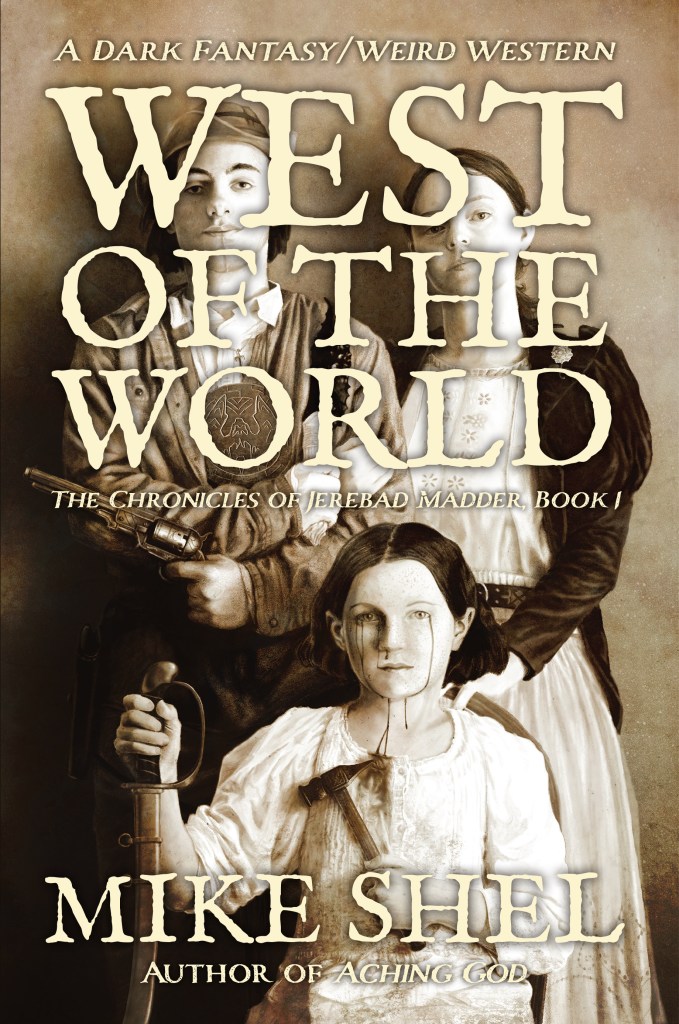
The Speculative Shelf is thrilled to welcome Mike Shel to the blog to discuss his upcoming novel West of the World, the first book in The Chronicles of Jerebad Madder series (pre-order here).

You can find our full review of the book here.

Book summary: Young Jerebad Madder fled his stifling life as an aristocrat’s son back in old Hanifax for the distant colonies of Nethe Mundis, the New World. He found adventure and romance, even learned to speak with the dead and summon fire during his time living with the Chokonee, the indigenous people of the continent. But now, Jerebad’s prospects are death, madness, or something altogether worse: he has unwittingly released an unclean spirit into the world, a devil that brings terrible suffering to anyone and anything it touches.

As a dirt witch and demon hunter, Jerebad pursues his quarry across the wilderness. But this devil is on Hell’s business: a secret, diabolical purpose that means catastrophe for all. Jerebad alone can stop the demon now…if he’s willing to make an unspeakable sacrifice that will imperil his very soul.


Q&A with author Mike Shel:

You’ve made a bit of a genre pivot from the dark sword-and-sorcery fantasy of the Iconoclasts Trilogy to a “weird western” that is somewhat lighter on the fantasy elements. Was that a conscious move on your part, or simply what the story necessitated after jumping two hundred years into the future, when sorcery is no longer in vogue?

MS: Well, the novel opens with our protagonist conversing with the corpse of a man recently hanged, so I might challenge the assumption of your question. It’s true that the colonists in this new world no longer have access to sorcery in the way they did back in the Hanifax of the Iconoclasts Trilogy, but sorcery is very much alive with the indigenous peoples whose lands those same colonists have usurped. And there are supernatural elements aplenty. I would still call this new series very much a dark fantasy tale.

But going from sword-and-sorcery to a weird western, yes, that is a pivot. I wanted to tell a story set in the world of the original trilogy, but long enough after those events that we see something of what the world has become. It’s not uncommon in fantasy for the stories to exist in a permanent, unchanging medieval or Renaissance era. I wanted to subvert that. I happen to love well-told westerns, such as Larry McMurtry’s Lonesome Dove novels. I thought I’d try my hand at such a story.

Honestly, the biggest change and challenge for me was to write this novel in the first person, which I had never done before.

The Indigenous groups that populate the western frontier seem to draw from existing Native American cultures. Were there specific cultures or traditions that influenced you while crafting these groups and their customs?

MS: I’m originally from Michigan, a place inhabited by the Anishinaabe peoples (tribes such as the Ojibwe, Odawa, and Potawatomi) when French and English settlers arrived. I drew from their cultures, as well as those of the Haudenosaunee Confederacy (AKA the Iroquois around Lakes Huron, Erie, and Ontario). Being an American who has consumed a considerable amount of folklore, novels, and TV, other Native American elements found their way into the depiction of West of the World’s indigenous people. For instance, the trickster deity known as Coyote (called Yoteh in the novel), is actually found in the mythology of the Diné (Navajo) people of the American southwest. I tried not to assemble a generic native people from a grab bag–that was certainly one of the risks; there are as many distinct cultures and traditions as there are distinct native tribes of North America. But it was challenging–the western is an almost inherently racist genre, told as it is so often by colonizers who either demonize or idealize the native peoples. I engaged a sensitivity reader for the purpose, and with her help I hope I was successful in making the Chokonee of the novel a three-dimensional people and culture.

This book tells a complete story but also functions as a jumping-off point for further adventures starring Jerebad Madder. Do you have a specific number of books planned?

MS: At this point I see two more novels. The second, which I’ve already begun, is called Thou Unclean Spirit and focuses on the calamitous, world-shaking fallout from the events of West of the World. The third is tentatively titled A Death Song and focuses more directly on resolving Jerebad’s personal travails (for some cheeky context: it takes place mostly in Hell). My hope and plan is that both are out within the next 18-20 months.

You’ve built a dedicated readership without putting out books through a traditional publisher, as evidenced by the more than $120,000 in combined backing for your three hardcover Kickstarter campaigns. How do you view your unique position in the publishing world?

MS: When you put it that way it makes me sound like a much bigger fish than I actually am! I’m certainly proud of the success I’ve managed with my novels, and greatly appreciate the support I’ve received from readers, reviewers, and my peers. Indie fantasy is a rich community with some awfully talented folks. I’m jazzed by the idea that I’m part of this cohort. But it’s important that you understand that I still have to work my day job to pay the bills–I’m nowhere close to doing this writing thing full time. (As for those Kickstarter figures, the vast majority of that money goes into paying artists, in addition to the design and production of the hardbacks–late pledges can be made here.) My assumption is that this will remain a glorious side gig for me til I can retire from my professional career.

With that said, I think what I bring to the game are the eclectic skills of an RPG adventure designer and one whose day job provides a lot of insight into human emotion and trauma. I strive to bring a gritty realism to a genre that can sometimes drift into escapism. Now there’s nothing wrong with novels that transport you to magic worlds that do a little wish fulfillment. I just think my strength lies in telling stories about survivors rather than golden heroes. 

What have you read recently that you would recommend?

MS: I don’t have much time to read these days. What I’ve been reading most recently is the beginning of a new series by J. Zachary Pike (he of the Dark Profit Saga): it’ll be some time before it’s available to the public, but it’s clever and hilarious. I’ve really enjoyed Dorian Hart’s five book Heroes of Spira.

Thank you so much for taking the time to offer such great insight into your work, Mike. I’ve loved all of your books and I think West of the World is another winner!

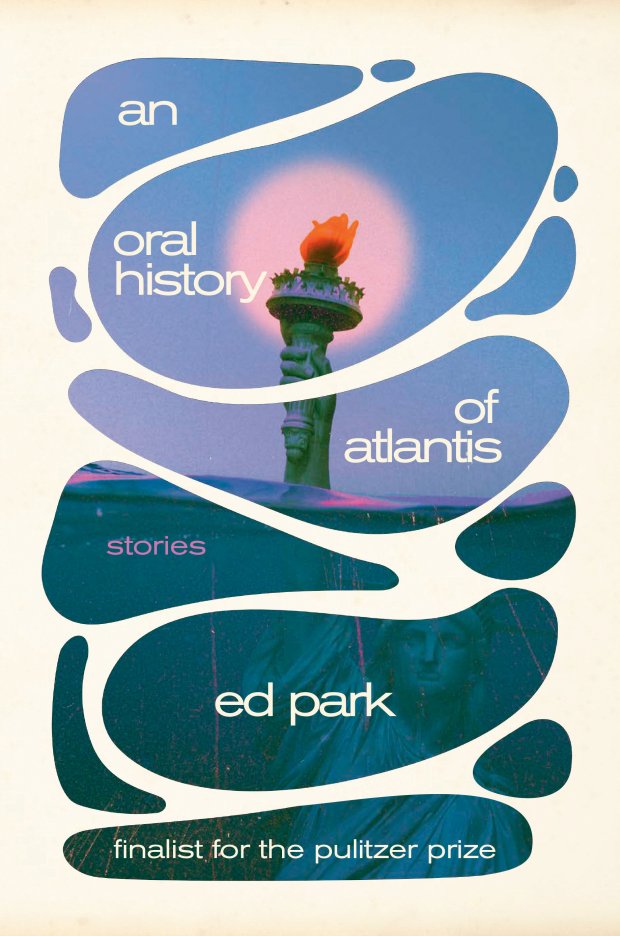
Interview: Ed Park, author of An Oral History of Atlantis


The Speculative Shelf is very excited to welcome Pulitzer Prize finalist Ed Park to the blog to discuss his wonderful new collection, An Oral History of Atlantis (out now from Penguin Random House).

You can find our full review of the book here.

Publisher’s summary: In Ed Park’s utterly original collection, An Oral History of Atlantis, characters bemoan their fleeting youth, focus on their breathing, meet cute, break up, write book reviews, translate ancient glyphs, bid on stuff online, whale watch, and once in a while find solace in the sublime. Throughout, Park deploys his trademark wit to create a world both strikingly recognizable and delightfully other. Spanning a quarter century, these sixteen stories tell the absurd truth about our lives. They capture the moment when the present becomes the past—and are proof positive that Ed Park is one of the most imaginative and insightful writers working today.


Q&A with author Ed Park:

Your work often plays with form, language, and meta-fiction. How do those experiments show up in this collection?

EP: I enjoyed finding different ways to transmit the various voices here. Three of the stories are letters (“A Note to My Translator,” “An Accurate Account,” and “The Gift”)—I love the epistolary form because the text has a “reason” to exist (i.e., someone is writing to someone else). The form envisions an audience. The most unusual structure can be found in “Weird Menace,” which is presented as a Blu-Ray commentary track on a science-fiction movie from the ’80s. I don’t know that they’re still doing commentary tracks, now that everything’s on streaming, but I used to find them pretty interesting—a whole new layer to the viewing experience.

There are some subtle interconnections from story to story: Were you purposely repeating characters and themes, or did those similarities unfold more organically?

EP: These stories were written across 25-plus years, sometimes with lengthy intervals between them, so I wasn’t always conscious of the connections. But I knew that certain names recurred, and I’d sometimes have a sense that one story (say, “Two Laptops”) might have some interesting connection with another (“The Air as Air”). Later, as I finalized the table of contents, I made a two-page chart so that I could see how these characters interacted with each other in various stories (and in fact “off the page”). I had to create rough biographies to make sure their chronologies intersected in a way that made sense—stuff that the reader doesn’t need to think about, but background that’s there in case he or she wants to probe deeper into the connections. 

I also like how the “blank space” between the stories can act like the passage of time. Hannah Hahn pops up in at least three places, in somewhat different. And Mercy Pang, the enigmatic artist in my novel Same Bed Different Dreams, actually made her first appearance in the story “Thought and Memory.” And you can trace another character from that story, Mimi, to at least two others in the book. 

When compiling a short story collection – how much thought goes into the order of the stories? Is it like sequencing an album tracklist or setting a baseball batting order – do you try to frontload your best ones? Or end with a bang?

EP: Quite a lot of thought! In a fun way.! I wanted to kick things off with “A Note to My Translator,” because it was my first published story (1998), and one that signals to the reader there’s plenty of humor ahead. In other words: This book will be fun. And I liked the idea of the title track coming at the end. The reader will have been thinking of the title through the course of the whole book, and now the “answer” will be revealed. (I also added a nod from this story back to “Note,” creating a loop of sorts.) 

Speaking of books being like albums, two—actually three—of the titles in AOHOA are taken from songs: “Bring on the Dancing Horses” (Echo and the Bunnymen), “Watch Your Step” (Elvis Costello), and “The Gift” (The Velvet Underground).  

The more explicitly speculative stories (“Eat Pray Click,” “Well-Moistened…,” the title story) are in the latter half of the book—I imagine that readers, having made it this far, are perhaps ready to go on a wilder ride. “Weird Menace”—the longest story here by far—is also something that wouldn’t necessarily work right out of the gate. 

On the other hand, I could imagine the reader dipping in at random—as one would listen to a CD on shuffle—and having a totally great experience. What if you read it backward?

There were 15 years between your debut novel Personal Days and your follow-up Same Bed Different Dreams in 2024, but it’s now been a quick turnaround to this collection? When might we see your next work? I’ve seen passing mentions of Three Tenses – a memoir “with fragments, observations, and anecdotes that form a picture of creativity in action.”  Is there anything else you can share about that?

EP: Yes, Three Tenses will be out next year, which I’m thrilled about. It’s a memoir that I wrote in 1998—fairly rapidly, with an intense sense of aesthetic purpose; then I put it in a drawer. The whole thing is rather lyrical and experimental, done in fragments, each one beginning with the same word. It’s a little like David Markson, a little like Oulipo. There are also strands that are pure fiction, woven in. I rediscovered the book in 2020, literally finding it in a box. I retyped the whole thing—a really unique experience. I write quite differently now, but there’s something about that early style that I find very attractive.

I’ve got another novel in progress. I don’t know when it will be done! But it’s been a lot of fun, and there’s some Buffalo/Korea content.

We’re both native Buffalonians and long-suffering fans of the Buffalo Sabres. The Sabres are in the midst of a historically rough stretch, missing the playoffs for 14 straight seasons and displaying a level of ineptitude the likes of which have rarely been seen in professional sports. That said…what gives you hope for the future? Will they (and can they) turn things around in our lifetimes?

EP: There’s always hope, as long as the team doesn’t go to another city. (The other day I was thinking of an alternate universe in which the Buffalo Braves had stayed in town; now they’re the Clippers.) Having said that, I’m distressed that they don’t know what to do with good players. Seeing so many ex-Sabres in the recent Stanley Cup finals was painful. 

Thank you so much for taking the time to offer such great insight into your work, Ed. I loved An Oral History of Atlantis and best of luck with its release!

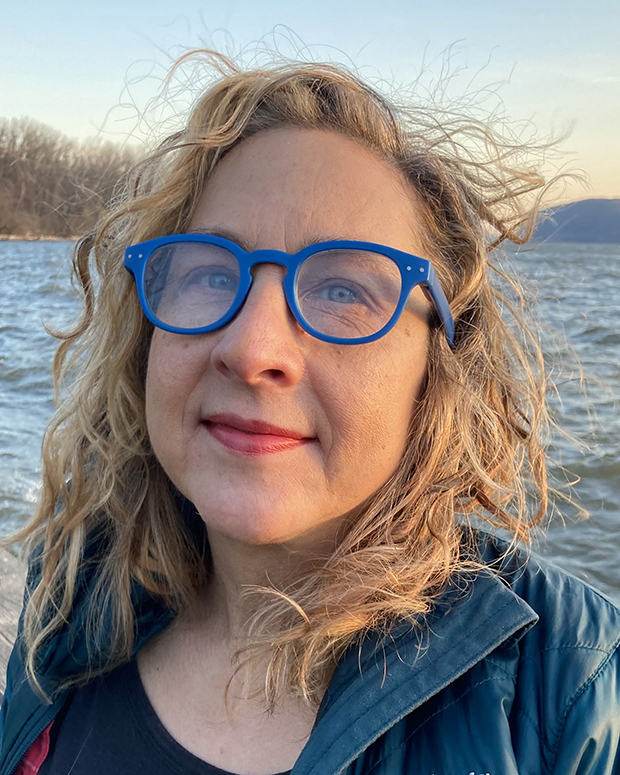
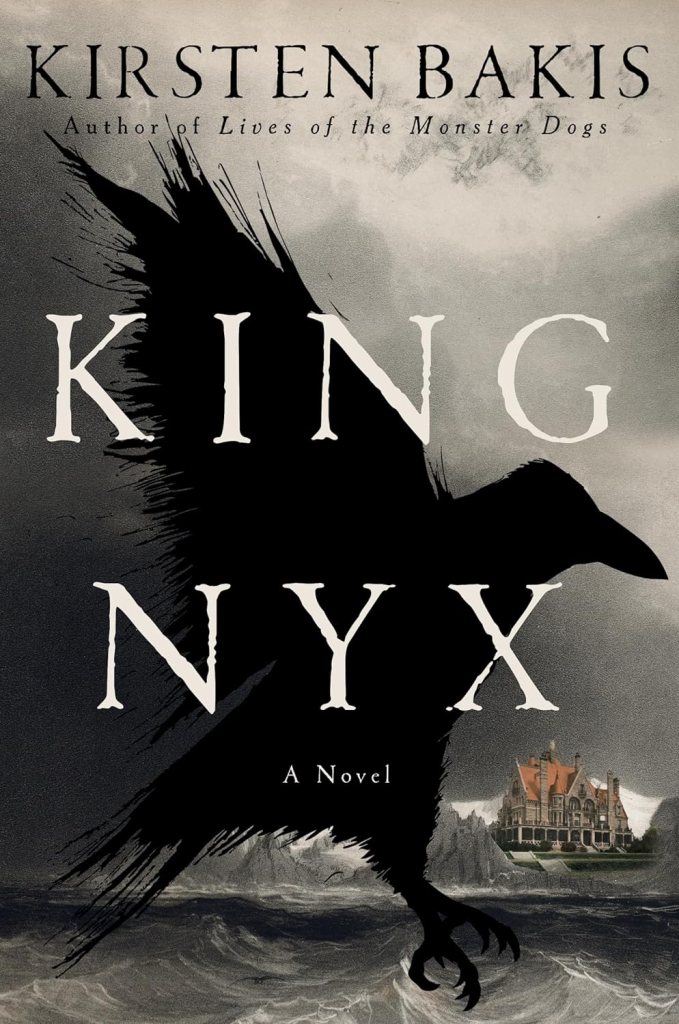
Interview: Kirsten Bakis, author of King Nyx


The Speculative Shelf is very excited to welcome Kirsten Bakis to the blog to discuss her brilliant new novel, King Nyx (out now from Liveright Books/Norton).

You can find our review of the book here.

Publisher’s summary:
Anna Fort wants to be a supportive wife, even if that means accompanying her husband for the winter of 1918 to a remote, frozen island estate so he can finish his book as the guest of an eccentric millionaire. When she learns three girls are missing from a school run by their host, Anna realizes finding them is up to her—even if that means risking her husband’s career, and possibly her life.


Q&A with author Kirsten Bakis:

Did you have prior knowledge of the Forts before writing the book? What drew you to them, and Anna Fort, in particular?

KB: I learned about Charles Fort years ago, and he stayed in my mind because he’s such an interesting character. For years, he spent his days in public libraries combing through books and scientific and meteorological journals in search of anomalous events, carefully copying out quotes and citations by hand, and bringing them home to file in a special cataloging system in shoeboxes. He wrote long rambling books putting forth a variety of strange and mismatched theories about why these things happened. For example, he suggested that red rain, or blood rain—which has been recorded in various times and places throughout history—might be caused by gigantic creatures in outer space fighting and bleeding. Sometimes he claimed he wasn’t serious, but his distrust of the scientific establishment and desire to poke holes in its logic (which he didn’t do a very good job of) did seem serious.

So, initially, I thought I would like to write a book about him. But the more I learned about his wife, Anna, the more I began to think that the really interesting story was hers. 

A lot of people thought Charles was a crank, but a few—notably the famous novelist Theodore Dreiser—thought he was a genius. As a result, Charles wound up publishing several books and making a name for himself. Today, we have hundreds of pages of his rambling thoughts, and hundreds more of notes by Theodore Dreiser for a never-published biography of Charles. But much less is known about Anna, the woman who made his writing career possible by working backbreaking domestic labor jobs and basically taking care of him in every way—and yet who was pretty silent on the topic of what she thought of his books. 

Dreiser, in his notes about a dinner he had with the Forts, dismissed her as being unable to understand her brilliant husband, and characterized her as a woman who “cannot think.”

She had once wanted to be a singer, but gave that up to take a backseat to her husband’s career. I do think the two of them genuinely loved each other, that she wanted him to succeed and that he appreciated her. But I couldn’t stop thinking about what that must have been like for her, and what might have played into her decision to prioritize him and his strange, nonsensical writings, which she herself didn’t seem to buy into. What made her choose to put her own desires on hold so that he could succeed? It’s such a familiar story, such a familiar dynamic. I wanted to examine it. 

Since not much is known about Anna Filing Fort, I made up a gothic, extravagant, sort of over-the-top adventure for her—something I wish she could have had, something I wanted to give her retroactively. 

The dialogue and language choices really do a great job capturing the distinct tone and feel of the time period. How did you channel that voice?

KB: Thank you. I’m not sure how it works, exactly, but I know I spent a lot of time researching the era, and reading the works of Charles Fort and others who wrote in the early 20th century. Not so much (for this purpose) the great writers with their own precise and distinct voices, like Virginia Woolf, but more ordinary things—chatty magazine articles, interviews, and that kind of thing. But I think most of it really happens when you’re sitting down and writing and just trying to—as you said—channel something. I do think that in some way, that’s what’s happening—you’re opening yourself up to voices that aren’t exactly yours, personalities that are different from your own. I have no idea how that works. It’s something so many writers talk about. I think there may be an element of actual magic.

Was it an intentional choice to tease a big spooky mansion and then put the characters on the outside looking in for most of the book?

KB: That’s a good question! I definitely think of gothic fiction as generally taking place partly inside a big spooky mansion, and King Nyx doesn’t, for most of the book. I want to say that it was a completely intentional and logical choice, but in truth, so much of writing happens by instinct. At some point I realized that they just weren’t going to get into the house until the end. So I decided to work with that. 

I do think that it’s a story about people who don’t get to inhabit the mansion—not really. Even if some of them do live in fine houses, they’re servants, or they’re, in some way, not in the center of power, and that fact shapes their lives. They orbit men who are the center, the sun, of their own little universes, and everyone else is just moving carefully around them. That’s part of what I see the story as being about.

What’s a piece of popular media (movie/TV show/book) you could fill in this blank with – “if you like _______ , you’ll like King Nyx.”

KB: This is a hard question! It’s so hard for me to see King Nyx from the outside. Maybe to put it in more general terms: if you like gothic fiction, if you like mystery, if you like feminism, if you like stories about eccentric millionaires, and creepy dolls, and suspense, and . . . talking birds??? — then you’ll like King Nyx.

I read that you haven’t reread your breakout debut, Lives of the Monster Dogs, in the 27 years since it’s been published. Do you think you’ll keep the same distance between yourself and King Nyx now that it’s out in the world?

KB: I think I might! It can be fun to try to translate a book into a really different form, like a screenplay, for example—where you really have to make changes to make it work. So that could be a reason to revisit something. But the idea of just re-reading it again as a novel doesn’t seem interesting to me. I’ve been over every inch of it, every word and comma, so many times, and that was fun, but I feel like it’s time to go onto other things.

What’s the last great book you read?

KB: I’ve been really enjoying Tana French’s novels lately. I especially love her first, In the Woods, which I read a few months ago, and also The Secret Place. She’s so good with suspense, and just a great, accomplished craftsperson—I’ve been taking a lot of notes as I read about what she’s doing and how she’s doing it. I’ve also recently discovered Seishi Yokomizo, a Japanese mystery novelist who published a lot in the mid-20th century. Pushkin Press, in the UK, is publishing English translations of some of them now. I loved The Village of Eight Graves and Death on Gokuman Island. They’re mysteries, but they also have a kind of folk-horror feel to them, which is true of a lot of Tana French’s work as well. A mix of folk horror and mystery is something I just love as a reader. I’m currently reading Victor LaValle’s Lone Women, which is historical horror, and it’s looking like it’s going to be fantastic.

Thank you so much for taking the time to offer such incredible insight into your work. I loved reading King Nyx and I think others will too!