Review: Unseemly Science

UnseemlyScience-144dpiTitle: Unseemly Science (2015)
Author: Rod Duncan
Pages: 368
Series: Fall of the Gas-Lit Empire #2 (Series Tracker)

Unseemly Science picks right back up with Elizabeth Barnabus attempting to solve a new mystery involving blocks of ice, body-snatchers, and an enigmatic charitable foundation. I found this to be a worthy sequel that lost only a bit of the magic from the first book. Author Rod Duncan has crafted an amusing, well-drawn story with a wonderful protagonist. The overall story has yet to feature much in the way of empires falling, as the series title suggests, so perhaps the third book is more towards that end. I look forward to finishing out this series in time for Rod Duncan’s new Elizabeth Barnabus series coming in 2018.

★★★¼ out of 5

Review: Children of Time

chaykovski.jpgTitle: Children of Time (2015)
Author: Adrian Tchaikovsky
Pages: 600

More often than not, I’m left feeling that a book with a cool/intriguing concept fails to properly deliver on said concept. Children of Time is an exception to this trend. I was blown away by how masterfully Tchaikovsky executes this evolutionary tale.

I was immediately hooked on the story, which builds and builds as a spider species on an alien planet evolves across millennia, while the last remnants of the human race exist in a sort of suspended stagnation just trying to survive in deep space. The narrative is told in a very straightforward way, with propulsive pacing and a tremendous amount of momentum. It’s engrossing from start to finish with few lulls along the way. It easily joins the ranks of my favorite science fiction novels. Read this!

★★★★¾  out of 5
SPECULATIVE SHELF STARRED BOOK

“Why should we be made thus, to improve and improve, unless it is to aspire?”

Review: Artemis

Artemis-Book-Cover-Andy-Weir.jpgTitle: Artemis (2017)
Author: Andy Weir
Pages: 384

My thanks to NetGalley and the publisher for an advanced reader copy in exchange for an honest review.

In Artemis, snarky smuggler Jazz Bashara gets caught up in a dangerous get-rich-quick scheme that could rock the foundations of life as they know it on Artemis, the first ever Moon city.

Well, two major books into his literary career, I think Andy Weir’s genre/style is apparent — sarcastic, genius narrators who Macgyver their way out of outer space jams. This leads to a generally palatable adventure that moves along swiftly and is enjoyable enough, but doesn’t linger very long with me after I’ve turned the final page (or hit 100% on my Kindle, in this case). Artemis is told in a very visual, fast-paced way, which I think will translate well to the big screen (the film rights have been acquired). As a point of comparison, I thought The Martian was better served in book form, whereas the opposite might be true about Artemis.

The concept of a moon colony has been done before, but I liked Weir’s take on what the economy would look like and how the creation of the outpost was firmly tied to corporations and the commercialization so prevalent in today’s society.

My major issue with the book was that it felt like Jazz had this tacked-on personality trait of being a promiscuous woman, even though it added nothing to the depth of her character or the story itself. Every repeated mention or dirty joke about it felt forced, unnecessary, problematic coming from a male author, and generally kinda icky.

Overall, this was a mostly enjoyable adventure story, with a likable cast of characters, in an interesting setting. I can’t give it a rousing recommendation, but if you loved The Martian, you’ll probably have fun with this.


★★★ out of 5

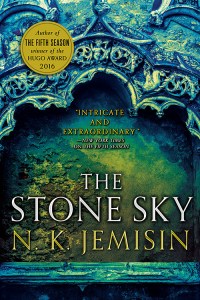
Review: The Stone Sky

Jemisin_StoneSky-TP.jpgTitle: The Stone Sky (2017)
Author: N.K. Jemisin
Pages: 413
Series: The Broken Earth #3 (Series Tracker)

“I don’t know what’s happening, not really. I know only that this is a battle, full of moment-to-moment confusion as all battles are, and from here forth nothing is quite clear…”
The Stone Sky

This quote sums up my experience with The Broken Earth trilogy. I was frequently perplexed by what exactly was happening from scene to scene, but I was always left in awe by Jemisin’s unique voice and vision.

My lower ratings for the previous two books (3.5 and 3.25) were due to, what I felt was, a lack of accessibility. I struggled to care about the setting, the characters, and their stories because it was such a conceptually idiosyncratic world. The Stone Sky feels more grounded in the familiar. The Earth they inhabit feels real and more analogous to the one we currently inhabit. The characters are more vulnerable and their stories are more focused and clear. …or perhaps the previous two books built a foundation on which I was able to engage more easily with what was going on here. Either way, this one is great!

Summarizing the plot here would not do justice to the sheer power of this book/series. It is, ultimately, a story of survival, oppression, power, love, and family. The Stone Sky is my favorite book of the trilogy and is a dazzling conclusion to a remarkable and devastating series. As a whole, this was a visionary work, written by a wonderfully imaginative author. I look forward to seeing what she creates next.

★★★★ out of 5

Review: Borne

passport_Borne-A-Novel-1519296-9fdd0708c6a0d663eb92Title: Borne (2017)
Author: Jeff VanderMeer
Pages: 325

Rachel is a young woman scavenging the ruins of a dilapidated city. She comes across Borne, a sea anemone-like creature affixed to the side of monstrous bear that patrols her territory. Rachel must contend with Borne’s growing sentience (and size) as her world crumbles around her.

Borne shares a lot of stylistic DNA with Jeff VanderMeer’s Annihilation, one of my favorite books of all time. This novel did not jibe with me in the same way, unfortunately. While Annihilation dealt with the slow creep of the unfamiliar into our known world, Borne shows a world already gone — a world filled with biotechnological monstrosities and a destroyed civilization. It’s a full embrace of the New Weird genre that VanderMeer has helped popularize, but it ultimately lost me along the way.

There are nuggets of really interesting ideas found within the pages of this novel, but I found the writing style to be ultimately inaccessible. Borne lacked a cohesive narrative and a compelling mystery, which made it difficult to stay invested. In the end, all the discordant sequences coalesced into something coherent, but it wasn’t enough to rectify the disinterest and confusion that came before it.

★★¼ out of 5

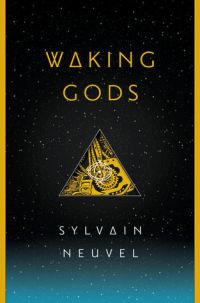
Review: Waking Gods

30134847Title: Waking Gods (2017)
Author: Sylvain Neuvel
Pages: 320
Series: The Themis Files #2 (Series Tracker)

My thanks to NetGalley and the publisher for an advanced reader copy in exchange for an honest review.

Last year, Sleeping Giants made my Best of 2016 list and I’m fairly confident Waking Gods has secured a spot on the 2017 list. While Sleeping Giants dealt with the discovery, assembly, and control of Themis, the buried robot relic of unknown origin — book #2 shows how a newly emboldened Earth deals with a threat far beyond what they are prepared to handle. Author Sylvain Neuvel takes the overall story in a bold direction that sees our returning protagonists confronted with a dozen new giant alien robots with unclear aims. Waking Gods is larger in scale, yet more personal in nature.

I love the continued use of interviews with shadowy characters who know much more than they are letting on. By slowly feeding crumbs of intel to the protagonists (and to us, by extension), they’re able to guide them into finding solutions for seemingly unsolvable problems; this serves to drive the narrative forward in a compelling way.

The epistolary format combines with Neuvel’s sharp writing to make for an infinitely readable sci-fi adventure that twists and turns its way to a big cliffhanger ending. I’m excited to see where the series goes from here.

★★★★¼ out of 5

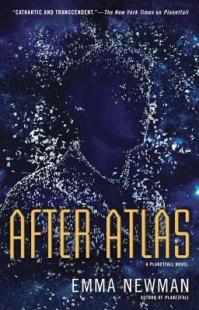
Review: After Atlas

28361265Title: After Atlas (2016)
Author: Emma Newman
Pages: 384


Planetfall (2015) has stuck in my mind since reading it last year. It had a haunting quality that I could not shake. After Atlas is a pseudo-sequel that takes place after the events of that novel, but exists adjacent to the original story. It certainly can function as a standalone novel, but knowing the backstory and outcome of Planetfall adds another layer to the reading experience that ended up being quite satisfying.

In the near future, technology has advanced to a point where everyone has their own virtual assistant, food comes out of printers, virtual reality is ubiquitous, and corporations (overtly) control governments. Some long for a simpler time, including those in the Circle, an anti-tech cult. When their messiah-like leader is found dead under mysterious circumstances, Carl Moreno, a detective and former Circle member, must solve the case while multiple nefarious factions attempt to stop him.

In this police procedural, let’s call it CSI: VR, author Emma Newman deftly lays out the clues and mysteries in a straightforward way, but the way the puzzle and solution come together is unexpected, yet makes perfect sense. The pieces fit together snugly and the whole is greater than the sum of its parts.

Another strength of After Atlas lies in Detective Moreno, the chief protagonist. He has so many forces acting and pulling on his psyche, from his own internal demons, to his tragic past, to his unending indentured servitude to his employer, and to unseen external forces that are conspiring against him. He is a complex hero who has a gratifying character arc.

The ending of After Atlas was final in a certain sense, but opened the possibility for a follow-up that would explore the continuation of the same story, but would switch up the genre yet again. I, for one, hope that comes to fruition. Emma Newman has emerged as an impressive voice in science fiction who writes interesting stories with depth and nuance. I look forward to seeing whatever else she cooks up in the future.

★★★★ out of 5
SPECULATIVE SHELF STARRED BOOK

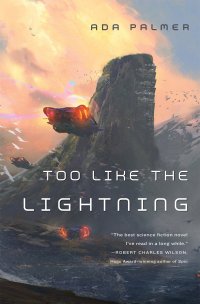
Review: Too Like the Lightning

81hifvbq-4lTitle: Too Like the Lightning (2016)
Author: Ada Palmer
Pages: 432
Series: Terra Ignota #1


Review:  Too Like the Lightning chronicles several days on Earth in the distant future, where flying cars zip through the sky, country borders have been dissolved, and war is non-existent.

This is a unique and challenging book that left me feeling quite conflicted. I will never complain about straightforward novels that spoon-feed information and exposition, but this was so far towards the opposite end of that spectrum that it made my head spin. Careful reading, backtracking, and re-reading were necessary to understand what exactly was going on. Author Ada Palmer makes you work for each revelation and concept contained in her deeply fleshed-out future world. And while the ideas presented and communicated feel prescient and thought-provoking, the work I put in far exceeded the enjoyment I took away.

There are shimmers of brilliance throughout, but it frequently crumbles under the weight of its own inaccessibility. The thoroughness required in reading actually left me so enmeshed within the world that, upon coming to the final page, I was disappointed that there was no definitive resolution. The story will continue in a sequel coming this February, but I may not be along for the ride.

★★¾ out of 5