Review: Before Mars

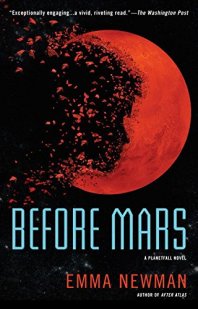
BeforeMarsTitle: Before Mars (2018)
Author: Emma Newman
Pages: 320
Series: Planetfall #3 (Series Tracker)

My thanks to NetGalley and the publisher for an advanced reader copy in exchange for an honest review.


Upon landing on Mars, geologist/artist Anna Kubrin is immediately suspicious of her surroundings after spotting a series of ominous clues scattered in and around her Martian research facility. She’s unable to ascertain whether she is actually in danger or if it is all a paranoid delusion. Either way, she’s at risk, but nothing will keep her from uncovering the truth.

This was a wonderfully captivating read that I really enjoyed. Author Emma Newman has a masterful way of imbuing her protagonists with vulnerability and emotional depth. It is clear, based on her dedication and acknowledgements, that Newman’s own personal experiences greatly shaped and informed how she painted Anna in this novel, which adds a refreshing layer of authenticity to the narrative. The first half of the novel focuses heavily on Anna and the life she left behind on Earth. At times, the story is bogged down by her internal monologue and crippling self-doubt, but this serves to establish the character and makes way for a strong second half filled with the story beats and action that I knew was waiting to be unveiled.

Although less haunting than Planetfall (2015) and featuring a less complex crime story than After Atlas (2016), Before Mars is a compelling mystery box novel and a worthy addition to the Planetfall universe. With three books released and another on the way, Newman is crafting a superb series of interconnected works, with each subsequent book sprouting a new narrative thread while building upon the stories of the previous books. These books have been excellent and each new one I devour further solidifies their must-read status for me. I hope the story continues well beyond the next installment that is due next year.

★★★★ out of 5

Review: Arm of the Sphinx

Bancroft_ArmoftheSphinx-TPTitle: Arm of the Sphinx (2018; first published 2014)
Author: Josiah Bancroft
Pages: 380
Series: The Books of Babel #2 (Series Tracker)

In my reading life, I want to get sucked into stories, invested in characters, enraptured by action, and delighted by prose. If only one or two of those boxes can be checked by any given book, I’m perfectly satisfied. Josiah Bancroft’s books check a fifth box — all of the above. Every page of Arm of the Sphinx is a delectable treat, with countless delightful passages, characters, and a story that gets more intriguing as mysteries build and questions are answered.

The Tower of Babel and its surrounding airspace feels pulled from a fairy tale. Bancroft has created a fantastical setting that remains beguiling and limitless in terms of storytelling possibilities. I’m enjoying learning more about the Tower and the direction that the story seems to be going in that regard.

This book expands upon the backstories of each character, doles out meaningful motivations, and pairs the characters up in fun and refreshing ways. The story hits a few lulls leading up to the sections involving the Sphinx, but things pick up again and finish with a satisfying flourish.

Like Senlin Ascends before it, Arm of the Sphinx is inventive, clever, and imbued with a sense of virtuousness and humanity. Bancroft is weaving together a wonderful series that has all the makings of a modern fantasy classic. I cannot wait to get my hands on The Hod King later this year.

★★★★½ out of 5
SPECULATIVE SHELF STARRED BOOK

Review: Quietus

35464401Title: Quietus (2018)
Author: Tristan Palmgren
Pages: 512

My thanks to NetGalley and the publisher for an advanced reader copy in exchange for an honest review.


With the assistance of a Carthusian monk, anthropologists from distant planes of the multiverse study the spread of the Black Death on Earth to better understand the plague that is ravaging their home civilization.

Ah yes, the ol’ Carthusian monk meets transdimensional anthropologist story that we’ve all read a thousand times before. But seriously, this is a bold swing from a fresh new voice in speculative fiction. Author Tristan Palmgren deserves major points for creativity, even though this historical fiction/science fiction mashup wasn’t totally my cup of tea.

I very much enjoyed the characterization of the monk Niccoluccio Caracciola, who, aside from having a great name, was my favorite character to follow. He functions as a reader proxy, who experiences the infiltration of the anthropologists and gets swept up into a massive conspiracy while tackling his own internal conflict that evolves over the course of the novel. Niccoluccio’s perspective grounds the narrative in some semblance of reality before the story careens away into a somewhat convoluted direction.

Quietus functions most effectively when it’s focused on its historical fiction beats and stumbles as it delves deeper into inaccessible science fiction elements. This, combined with slow pacing, and a story that feels 150 pages too long, leads to a lower rating than I wanted to give. Author Palmgren has a knack for original storytelling, but the blending of two disparate genres didn’t quite work for me.

★★★ out of 5

Review: The Only Harmless Great Thing

81R7TYYgSvLTitle: The Only Harmless Great Thing (2018)
Author: Brooke Bolander
Pages: 96

The Only Harmless Great Thing tells a heartbreaking tale of victimization, injustice, and the bonds shared by all living things. Based loosely on true events, author Brooke Bolander uses killer prose to weave a dark alternate history that demands to be read in one sitting.

This was a novella that I appreciated more than I enjoyed. It features heavy themes and an interwoven narrative that is sometimes difficult to decipher. I suspect that rereading this thin tome would reveal even more layers of meaning than may have been apparent on my first read-through.

★★★½ out of 5

Review: Semiosis

Semiosis.jpgTitle: Semiosis (2018)
Author: Sue Burke
Pages: 338

My thanks to NetGalley and the publisher for an advanced reader copy in exchange for an honest review.

Upon arriving on Pax, a faraway Earth-like planet, human colonists seek to build a peaceful society despite territorial native plants and harsh conditions. The story is told over 100+ years and across several generations of settlers.

I immediately drew parallels between Semiosis and aspects of other recent works of science fiction — the multi-generational narrative of Children of Time, the planet colonizing and community building of Planetfall, and the alien communication angle of Arrival to name a few. As the story moves forward, though, this book forges its own path and becomes wholly original.

Author Sue Burke brings flora to life (both literally and figuratively) in such a skillful way that I was shocked to find that she is not a botanist-turned-novelist. Infusing plants with sentiency and agency adds an eerie quality to this book that was difficult to shake.

Structurally, the beginning sections were much more interesting to me as the time jumps moved us quickly from generation to generation, but things felt stagnant in the final few sections as the focus shifts to one pivotal event instead of years and years of progress. I see the value in altering the plot progression and story beats to keep things fresh, but things slowed down and got stuck focusing on some minutiae that was less appealing to me.

Nevertheless, Semiosis is solid debut novel that nicely executes a high-concept format. It’s disquieting, clever, and a change of pace from what I’m used to reading. I would be intrigued to see what sort of future Sue Burke could cultivate for future generations of the Pax commonwealth should a sequel bear fruit.

★★★¾ out of 5

Review: Iron Gold

Iron Gold.jpgTitle: Iron Gold (2018)
Author: Pierce Brown
Pages: 624
Series: Red Rising #4 (Series Tracker)

I have fond memories of the first Red Rising novel, but was less enamored with the subsequent two volumes. Because of this, I was hesitant to embrace Iron Gold, the first book in a new, tacked-on trilogy. Once I began, however, I found this to be a wholly worthwhile addition to Darrow’s story that breathes fresh life into the overall saga. This is popcorn sci-fi of the highest order.

Now utilizing multiple POVs to expand the scope of the story, author Pierce Brown tells four unique narratives, each engrossing in their own way. Brown does a good job balancing the POVs, but sometimes the story feels too expansive, with more characters and backstories than I could keep straight, even with a handy, inset character list. There’s certainly a heavier focus on house politics and family dynamics than I remember in previous Red Rising novels and I enjoyed that more than the bombastic, interplanetary space battles that featured so heavily in the previous two books.

Overall, Iron Gold is sprawling, electrifying, bloody, and represents a welcome return to form for the series. There is plenty of set-up for future novels, while featuring enough satisfying closure to contained storylines to be effective. I’m excited for what comes next!

★★★★¼ out of 5

Review: Children of Time

chaykovski.jpgTitle: Children of Time (2015)
Author: Adrian Tchaikovsky
Pages: 600

More often than not, I’m left feeling that a book with a cool/intriguing concept fails to properly deliver on said concept. Children of Time is an exception to this trend. I was blown away by how masterfully Tchaikovsky executes this evolutionary tale.

I was immediately hooked on the story, which builds and builds as a spider species on an alien planet evolves across millennia, while the last remnants of the human race exist in a sort of suspended stagnation just trying to survive in deep space. The narrative is told in a very straightforward way, with propulsive pacing and a tremendous amount of momentum. It’s engrossing from start to finish with few lulls along the way. It easily joins the ranks of my favorite science fiction novels. Read this!

★★★★¾  out of 5
SPECULATIVE SHELF STARRED BOOK

“Why should we be made thus, to improve and improve, unless it is to aspire?”

Review: Artemis

Artemis-Book-Cover-Andy-Weir.jpgTitle: Artemis (2017)
Author: Andy Weir
Pages: 384

My thanks to NetGalley and the publisher for an advanced reader copy in exchange for an honest review.

In Artemis, snarky smuggler Jazz Bashara gets caught up in a dangerous get-rich-quick scheme that could rock the foundations of life as they know it on Artemis, the first ever Moon city.

Well, two major books into his literary career, I think Andy Weir’s genre/style is apparent — sarcastic, genius narrators who Macgyver their way out of outer space jams. This leads to a generally palatable adventure that moves along swiftly and is enjoyable enough, but doesn’t linger very long with me after I’ve turned the final page (or hit 100% on my Kindle, in this case). Artemis is told in a very visual, fast-paced way, which I think will translate well to the big screen (the film rights have been acquired). As a point of comparison, I thought The Martian was better served in book form, whereas the opposite might be true about Artemis.

The concept of a moon colony has been done before, but I liked Weir’s take on what the economy would look like and how the creation of the outpost was firmly tied to corporations and the commercialization so prevalent in today’s society.

My major issue with the book was that it felt like Jazz had this tacked-on personality trait of being a promiscuous woman, even though it added nothing to the depth of her character or the story itself. Every repeated mention or dirty joke about it felt forced, unnecessary, problematic coming from a male author, and generally kinda icky.

Overall, this was a mostly enjoyable adventure story, with a likable cast of characters, in an interesting setting. I can’t give it a rousing recommendation, but if you loved The Martian, you’ll probably have fun with this.


★★★ out of 5

Review: Sea of Rust

32617610Title: Sea of Rust (2017)
Author: C. Robert Cargill
Pages: 416

My thanks to NetGalley and the publisher for an advanced reader copy in exchange for an honest review.

Brittle, a lone Caregiver robot, scavenges for functioning parts in the desolate Sea of Rust. Along her journey she encounters factions of robots that have differing visions of how the post-human world should be. It’s marketed as something akin to The Martian, but it feels much more like a quirkier story out of The Terminator universe.

This was an interesting take on the post-apocalyptic genre and I enjoyed it quite a bit. The story jumps between pre- and post-robot uprising and I found myself more invested in the chapters that described the history of the world before the apocalypse versus the present day narrative. Every aspect of this “what-if” world is well thought out and nicely conveyed to the reader.

For a story about metal automatons and artificial intelligence, Sea of Rust employs a surprising amount of emotional heft. Brittle’s tale is one of angst, loss, and survival. I couldn’t help drawing parallels to The Mechanical by Ian Tregillis, a favorite of mine that dives even deeper into the psyche of robotkind and explores what it really means to have free will. Sea of Rust is not at that level, but it is a serviceable and enjoyable ride nonetheless.

★★★¼ out of 5