
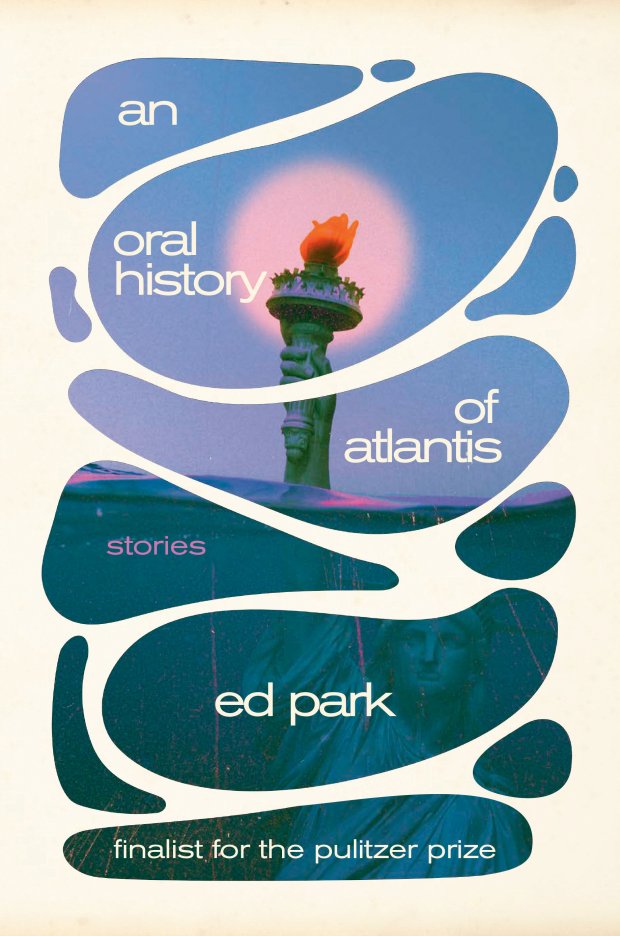
The Speculative Shelf is very excited to welcome Pulitzer Prize finalist Ed Park to the blog to discuss his wonderful new collection, An Oral History of Atlantis (out now from Penguin Random House).
You can find our full review of the book here.
Publisher’s summary: In Ed Park’s utterly original collection, An Oral History of Atlantis, characters bemoan their fleeting youth, focus on their breathing, meet cute, break up, write book reviews, translate ancient glyphs, bid on stuff online, whale watch, and once in a while find solace in the sublime. Throughout, Park deploys his trademark wit to create a world both strikingly recognizable and delightfully other. Spanning a quarter century, these sixteen stories tell the absurd truth about our lives. They capture the moment when the present becomes the past—and are proof positive that Ed Park is one of the most imaginative and insightful writers working today.
Q&A with author Ed Park:
Your work often plays with form, language, and meta-fiction. How do those experiments show up in this collection?
EP: I enjoyed finding different ways to transmit the various voices here. Three of the stories are letters (“A Note to My Translator,” “An Accurate Account,” and “The Gift”)—I love the epistolary form because the text has a “reason” to exist (i.e., someone is writing to someone else). The form envisions an audience. The most unusual structure can be found in “Weird Menace,” which is presented as a Blu-Ray commentary track on a science-fiction movie from the ’80s. I don’t know that they’re still doing commentary tracks, now that everything’s on streaming, but I used to find them pretty interesting—a whole new layer to the viewing experience.
There are some subtle interconnections from story to story: Were you purposely repeating characters and themes, or did those similarities unfold more organically?
EP: These stories were written across 25-plus years, sometimes with lengthy intervals between them, so I wasn’t always conscious of the connections. But I knew that certain names recurred, and I’d sometimes have a sense that one story (say, “Two Laptops”) might have some interesting connection with another (“The Air as Air”). Later, as I finalized the table of contents, I made a two-page chart so that I could see how these characters interacted with each other in various stories (and in fact “off the page”). I had to create rough biographies to make sure their chronologies intersected in a way that made sense—stuff that the reader doesn’t need to think about, but background that’s there in case he or she wants to probe deeper into the connections.
I also like how the “blank space” between the stories can act like the passage of time. Hannah Hahn pops up in at least three places, in somewhat different. And Mercy Pang, the enigmatic artist in my novel Same Bed Different Dreams, actually made her first appearance in the story “Thought and Memory.” And you can trace another character from that story, Mimi, to at least two others in the book.
When compiling a short story collection – how much thought goes into the order of the stories? Is it like sequencing an album tracklist or setting a baseball batting order – do you try to frontload your best ones? Or end with a bang?
EP: Quite a lot of thought! In a fun way.! I wanted to kick things off with “A Note to My Translator,” because it was my first published story (1998), and one that signals to the reader there’s plenty of humor ahead. In other words: This book will be fun. And I liked the idea of the title track coming at the end. The reader will have been thinking of the title through the course of the whole book, and now the “answer” will be revealed. (I also added a nod from this story back to “Note,” creating a loop of sorts.)
Speaking of books being like albums, two—actually three—of the titles in AOHOA are taken from songs: “Bring on the Dancing Horses” (Echo and the Bunnymen), “Watch Your Step” (Elvis Costello), and “The Gift” (The Velvet Underground).
The more explicitly speculative stories (“Eat Pray Click,” “Well-Moistened…,” the title story) are in the latter half of the book—I imagine that readers, having made it this far, are perhaps ready to go on a wilder ride. “Weird Menace”—the longest story here by far—is also something that wouldn’t necessarily work right out of the gate.
On the other hand, I could imagine the reader dipping in at random—as one would listen to a CD on shuffle—and having a totally great experience. What if you read it backward?
There were 15 years between your debut novel Personal Days and your follow-up Same Bed Different Dreams in 2024, but it’s now been a quick turnaround to this collection? When might we see your next work? I’ve seen passing mentions of Three Tenses – a memoir “with fragments, observations, and anecdotes that form a picture of creativity in action.” Is there anything else you can share about that?
EP: Yes, Three Tenses will be out next year, which I’m thrilled about. It’s a memoir that I wrote in 1998—fairly rapidly, with an intense sense of aesthetic purpose; then I put it in a drawer. The whole thing is rather lyrical and experimental, done in fragments, each one beginning with the same word. It’s a little like David Markson, a little like Oulipo. There are also strands that are pure fiction, woven in. I rediscovered the book in 2020, literally finding it in a box. I retyped the whole thing—a really unique experience. I write quite differently now, but there’s something about that early style that I find very attractive.
I’ve got another novel in progress. I don’t know when it will be done! But it’s been a lot of fun, and there’s some Buffalo/Korea content.
We’re both native Buffalonians and long-suffering fans of the Buffalo Sabres. The Sabres are in the midst of a historically rough stretch, missing the playoffs for 14 straight seasons and displaying a level of ineptitude the likes of which have rarely been seen in professional sports. That said…what gives you hope for the future? Will they (and can they) turn things around in our lifetimes?
EP: There’s always hope, as long as the team doesn’t go to another city. (The other day I was thinking of an alternate universe in which the Buffalo Braves had stayed in town; now they’re the Clippers.) Having said that, I’m distressed that they don’t know what to do with good players. Seeing so many ex-Sabres in the recent Stanley Cup finals was painful.
Thank you so much for taking the time to offer such great insight into your work, Ed. I loved An Oral History of Atlantis and best of luck with its release!





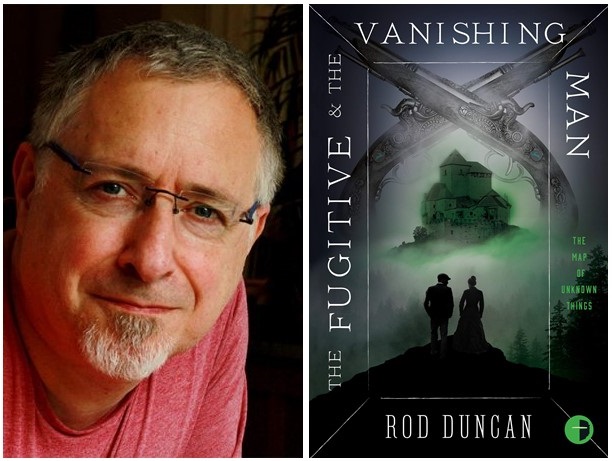 The Speculative Shelf is excited to welcome Rod Duncan to the blog today for a
  But, from your question, I’m guessing you’ve spotted various connections between book one and book six, The Fugitive and the Vanishing Man. The most obvious perhaps is the motif of Elizabeth’s pistol with the emblem of the leaping Hare inlaid in turquoise on the
  The Speculative Shelf