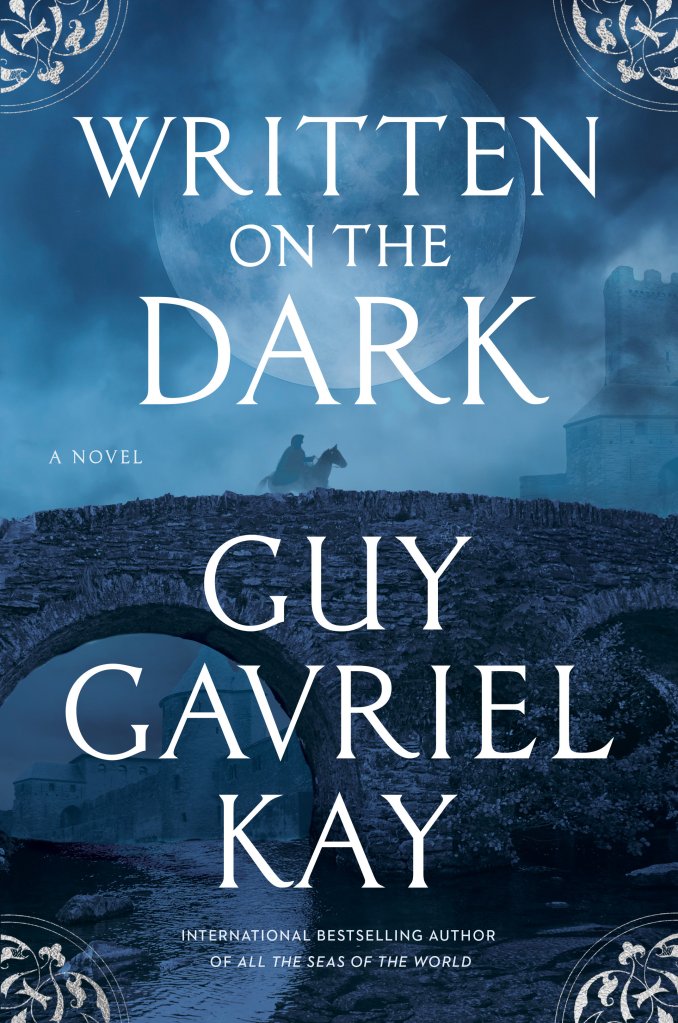
Review: Written on the Dark

Title: Written on the Dark
Author: Guy Gavriel Kay
Pages: 400
Release: May 27, 2025


It’s such a treat to get lost in Kay’s worlds, experiencing his unique spin on history with a splash of the fantastical. While this tale doesn’t break new ground or reinvent the genre, it’s an engaging and satisfying story that longtime fans of GGK and newcomers alike will certainly enjoy. The narrative isn’t as complex as some of his other works, featuring more accessible prose and POVs that stay close to the main action.

Though somewhat muted in its telling, there’s a glimmer of Kay’s storytelling spark shining through the fog – guiding us toward the light. His main character, Thierry Villar, who self-identifies as “inconsequential” to the world at large, is given his moment to shine as Kay builds his legend before our eyes. 

I’ve always loved how Kay grants even the most minor characters narrative arcs – sometimes in just a sentence or a paragraph, or, in this case, an entire book. Here, a tavern poet of medium renown makes his own indelible mark on the world. Someone who might have been a footnote in another story instead steals the spotlight.

★★★½

My thanks to the publisher and NetGalley for an advanced reader copy in exchange for an honest review.
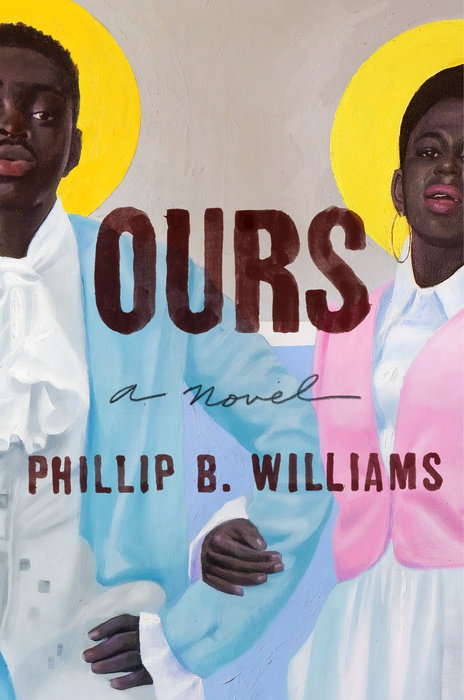
Review: Ours

Title: Ours
Author: Phillip B. Williams
Pages: 592
Release: February 20, 2024


An absolute masterclass in storytelling. Ours is a tour de force and one of the best novels I’ve read in ages.


I cannot say enough good things about Ours, an epic historical fantasy set in an enchanted town named Ours that serves as a safe haven for freed slaves. Told over four decades, Phillip B. Williams charts the plight of Ours and its inhabitants as they experience the challenges and triumphs of being free and safe amidst a still-hostile world. It’s epic in scope, dense and demanding, but it’s extremely rewarding. 

Williams is a poet and that becomes abundantly clear the more time you spend immersed in the book. Each sentence and paragraph is so beautifully crafted and it was a pleasure to luxuriate in his words. Please do not be scared away by the high page count as each and every page is infused with magic, wonder, and heart.

★★★★★
✪ SPECULATIVE SHELF STARRED BOOK

My thanks to the public library for providing me with a post-release copy in exchange for a promise that I’ll return it within 14 days. (I did).

Review: A Brightness Long Ago

ABrightnessLongAgoTitle: A Brightness Long Ago (2019)
Author: Guy Gavriel Kay
Pages: 448


I spent the first few months of 2019 reading Guy Gavriel Kay’s early works (for the first time) as a primer to this book’s release. I polished off his first six novels and thought I was ready to dive in here until I saw the world map that features “Sarantium” quite prominently – I closed the booked and jumped back and read Kay’s Sarantine Mosaic as final preparation. I’m glad I did, because that duology enhanced my understanding of this world and there are several callbacks within Brightness to the events in those books. Here, Kay is exploring the ripples of time, how small actions have an impact on the world at large and how our memory of the past shapes our understanding of our future.

Much like Kay’s previous work, A Brightness Long Ago is beautifully composed, emotionally engaging, and it features compelling characters with depth. I really loved being introduced to minor, seemingly inconsequential characters who, once they had played their part in this specific narrative, have the remainder of their lives described to us and how consequential they end up being in their own right.

As much as I enjoy Kay’s writing, I hit a wall about midway through here and really limped my way to the end over several weeks. Whether a result of my own disjointed pacing or the book’s, I was never quite hooked. That kept it from full 4-star territory, but I will gladly continue on with GGK’s oeuvre.

★★★¾ out of 5

“We see only glimpses of history, even our own. It is not entirely ours – in memory, in writing it down, in hearing or in reading it. We can reclaim only part of the past. Sometimes it is enough…”

My thanks to NetGalley and the publisher for an advanced reader copy in exchange for an honest review.

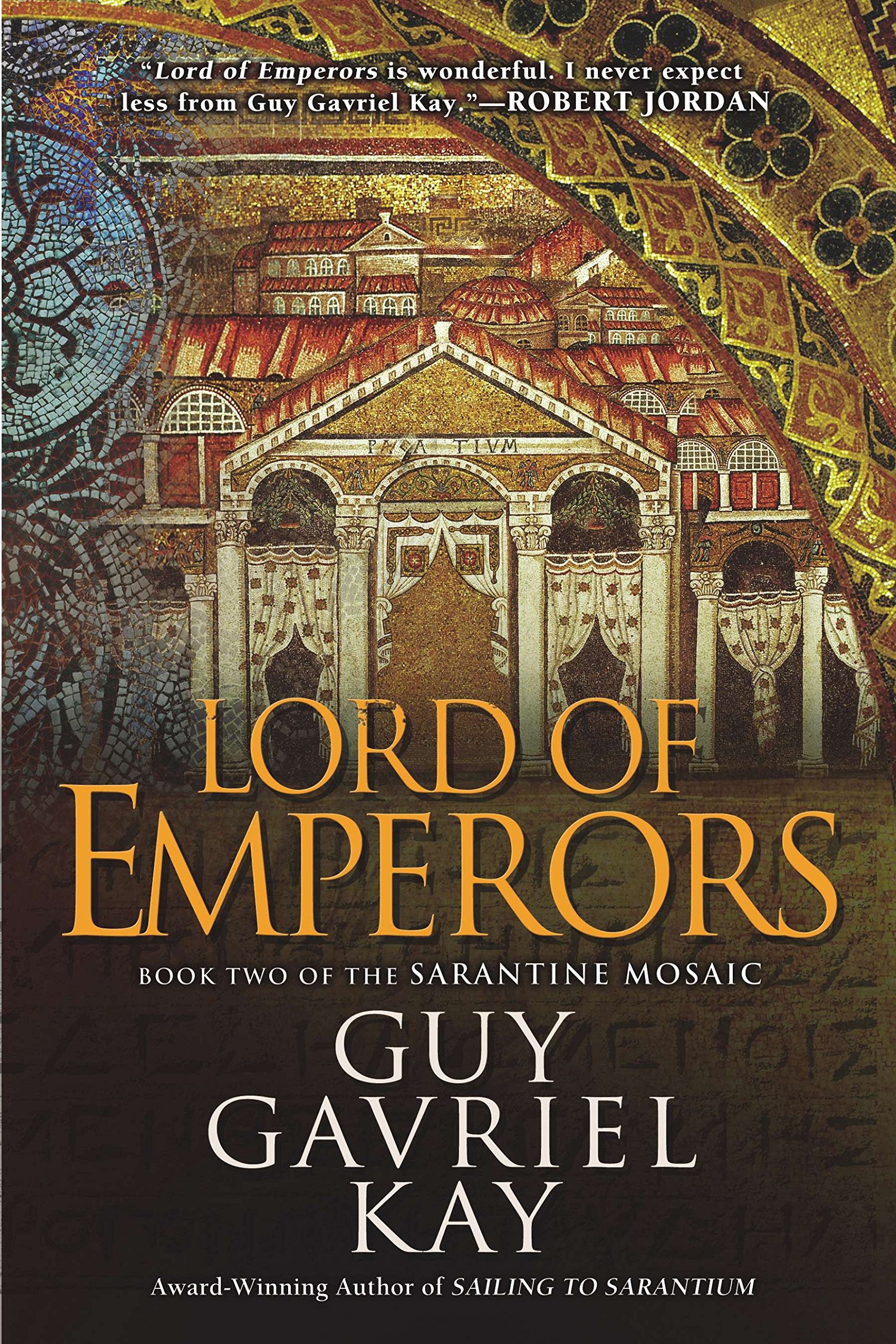
Review: Lord of Emperors

lordofemperorsTitle: Lord of Emperors (2000)
Author: Guy Gavriel Kay
Pages: 580
Series: The Sarantine Mosaic #2 (Series Tracker)


Coming off the great Sailing to Sarantium, I was let down by part two of this duology. This book expands on several story threads and introduces new characters that I struggled to invest in. I would have been perfectly satisfied with a book solely focused on Crispin and the construction of his grand mosaic. Kay pushes the story well beyond the reaches of Crispin’s plight and, in doing so, created a story that feels uneven, unwieldy, and mostly uninteresting to me. It is still beautifully written and ambitious, so I certainly do not regret finishing it, but it falls towards the bottom of what I’ve read from GGK so far.

★★★ out of 5

Review: Sailing to Sarantium

A1xQ-hkfksLTitle: Sailing to Sarantium (1998)
Author: Guy Gavriel Kay
Pages: 448
Series: The Sarantine Mosaic #1 (Series Tracker)


This first installment of the Sarantine Mosaic is wondrous, wonderful, and features some of the most beautiful passages that I’ve read yet from Guy Gavriel Kay.

The spirituality of the world and the exquisite mosaics that Kay describes are sights to behold. I’m fully invested in Crispin, his mosaic masterwork, the political web he’s fallen into, and the underlying mystical “half-world” that is nipping at his heels. The pacing of the overall story is uneven, but this is a great first half of a larger mosaic.

★★★★ out of 5

Review: The Lions of Al-Rassan

y648.jpgTitle: The Lions of Al-Rassan (1995)
Author: Guy Gavriel Kay
Pages: 510


As I continue to work my way through Guy Gavriel Kay’s work, I’ve arrived at The Lions of Al-Rassan, a book that many consider to be Kay’s best work. It certainly has the swiftest pacing of any of his books (that I’ve read so far). He deftly moves his characters around the map, while their allegiances shift and swirl and their cultures clash. It was a bit dizzying trying to piece together who was siding with whom at one point or another and sometimes the characters motivations didn’t always make sense to me. This made it difficult for me to connect with the main players. In the end, it was a solid story about complex heroes and compelling cultures. It was not my favorite GGK book, but I had a good time with it.

★★★¾ out of 5

Review: A Song for Arbonne

ASongforArbonneTitle: A Song for Arbonne (1992)
Author: Guy Gavriel Kay
Pages: 510


After Tigana and now A Song for Arbonne, it is clear that Guy Gavriel Kay can weave a complete, satisfying story in one standalone book. This novel is a beautiful tale of love and loss in the land of Arbonne. Kay’s character development and worldbuilding are outstanding and his lyrical prose is a perfect match for a sweeping story of troubadours amid a unique medieval world.

★★★★½ out of 5
SPECULATIVE SHELF STARRED BOOK

Review: Tigana

91wlmjEBnGL.jpgTitle: Tigana (1990)
Author: Guy Gavriel Kay
Pages: 676


Two sorcerous lords battle for control of the territory they occupy, while the original inhabitants of the land attempt to win back control from their occupiers and reclaim Tigana, their (literally) forgotten homeland. Tigana explores imperialism, occupation, and memory through a fantasy lens and does so in an effective and thoughtful way.

This is a wonderful book an engaging, beautifully told tale, with well-drawn characters and clever storytelling. The first 100 pages were superb, then it spins its wheels for a few hundred pages, before finishing with a flourish. It all felt worthwhile in the end and I am grateful for the reading experience.

★★★★¼ out of 5

Review: Quietus

35464401Title: Quietus (2018)
Author: Tristan Palmgren
Pages: 512

My thanks to NetGalley and the publisher for an advanced reader copy in exchange for an honest review.


With the assistance of a Carthusian monk, anthropologists from distant planes of the multiverse study the spread of the Black Death on Earth to better understand the plague that is ravaging their home civilization.

Ah yes, the ol’ Carthusian monk meets transdimensional anthropologist story that we’ve all read a thousand times before. But seriously, this is a bold swing from a fresh new voice in speculative fiction. Author Tristan Palmgren deserves major points for creativity, even though this historical fiction/science fiction mashup wasn’t totally my cup of tea.

I very much enjoyed the characterization of the monk Niccoluccio Caracciola, who, aside from having a great name, was my favorite character to follow. He functions as a reader proxy, who experiences the infiltration of the anthropologists and gets swept up into a massive conspiracy while tackling his own internal conflict that evolves over the course of the novel. Niccoluccio’s perspective grounds the narrative in some semblance of reality before the story careens away into a somewhat convoluted direction.

Quietus functions most effectively when it’s focused on its historical fiction beats and stumbles as it delves deeper into inaccessible science fiction elements. This, combined with slow pacing, and a story that feels 150 pages too long, leads to a lower rating than I wanted to give. Author Palmgren has a knack for original storytelling, but the blending of two disparate genres didn’t quite work for me.

★★★ out of 5