Review: Brother’s Ruin

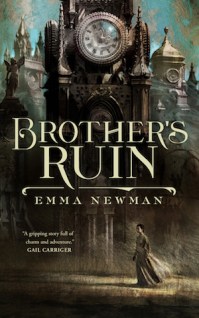
brothers-ruinTitle: Brother’s Ruin (2017)
Author: Emma Newman
Pages: 160
Series:
Industrial Magic #1
My thanks to NetGalley and the publisher for an advanced reader copy in exchange for an honest review.


The Royal Society of Esoteric Arts provides stability and prosperity to Great Britain through the tireless work of their Magi. Latent magi are highly sought after, but, once discovered, must forgo their normal life for one solely in service to the Crown. With her autonomy threatened, Charlotte, a young mage, hides her abilities from the world. When her father foolishly offers Charlotte’s feeble brother up to the Royal Society in desperate hopes of landing the large windfall that comes with selection, Charlotte must use her abilities to save brother, her family, and her entire way of life.

This novella, very much a Part 1 to a larger story, did not hook me from the start. It seemed that Emma Newman’s flair for storytelling was not on full display at the outset and may have been hampered by the novella format. Slowly, but surely, as the narrative unfolded, I was more and more invested…until it all ends abruptly — just when I was ready for more!

With such an interesting gaslamp sandbox to play in, I had hoped for more worldbuilding and a wider scope. Hopefully that comes in future installments, as Brother’s Ruin feels like the appetizer to a (potentially delicious) five-course meal.

★★★ out of 5

While I was reading this I was delighted to see the news that Emma Newman will pen two more Planetfall novels. I first discovered Newman through those novels, and I look forward to seeing where she goes next in that world.
Review: Passing Strange

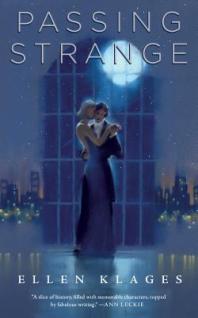
passing-strangeTitle: Passing Strange (2017)
Author: Ellen Klages
Pages: 220


Passing Strange is a story of love and friendship among six women in 1940s San Francisco. Author Ellen Klages employs elegant prose, a straightforward plot, and a splash of magic to construct this beautiful and well-told story. Everything here works well, but nothing about it blew me away. That being said, I would read an entire book of Klages describing pastries!

★★★½ out of 5

Review: Lincoln in the Bardo

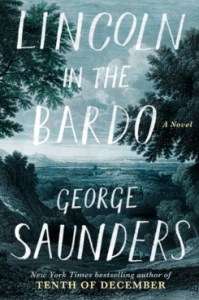
19-lincoln-in-the-bardo-w245-h368Title: Lincoln in the Bardo (2017)
Author: George Saunders
Pages: 343


After mastering the art of short fiction storytelling, author George Saunders has written Lincoln in the Bardo, his first full-length novel. It is one of the least conventional novels you will ever come across. Chaotic in both form and story, Saunders employs a mix of primary and secondary sources (some authentic; some completely made up) interwoven with the conversations of loitering, spirit-like entities trapped in the “bardo,” where the manifestation of their consciousness waits for their next birth. Very straightforward, right?

The story at the forefront of this madness is the death of Abraham Lincoln’s son Willie, and Lincoln’s mournful visits to his grave. Simultaneously, Willie’s spirit is floating around with all the other residents of the cemetery, as they each seek absolution in their own way. It is a powerful meditation on grief and loss, with a welcome dash of biting humor.

The unsystematic patchwork of storytelling modes is often bewildering in its construction, so, as the reader, you must (cliche alert) make it more about the journey than the destination. Despite the oodles and oodles of originality, the experience is too bizarre and unnerving for the ride to be worth it. I hope to revisit this story in audiobook form, as the star-studded voice cast may add a layer of familiarity to what is, in practice, a very alien novel.

★★★ out of 5

Review: Assassin’s Quest

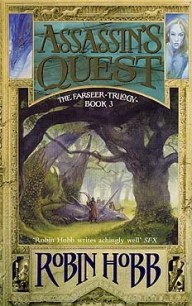
robin_hobb_-_assassins_quest_coverTitle: Assassin’s Quest (1997)
Author: Robin Hobb
Pages: 839
Series: Farseer Trilogy #3, Realms of the Elderlings #3 (Series Tracker)

Robin Hobb writes character relationships like no one I’ve read. In Royal Assassin, the novel directly preceding this one, that skill is on full display — FitzChivalry Farseer is in a castle surrounded by his enemies, his allies, his confidants, and his lover. Fitz’s interwoven relationships with these groups made for a very satisfying level of court intrigue.  In Assassin’s Quest, Fitz casts off on his own, leaving Buckkeep behind. It reminded me of the disappointment I felt toward the end of the Harry Potter series, when Harry is no longer at Hogwarts. Harry moves from place to place, spending large chunks of time camped in the woods. It never quite feels as magical as it did back within the confines of Hogwarts.

The word “Quest” in the title is apt. Fitz journeys relentlessly. There are only so many times one can make camp, hunt, and evade capture before it becomes a trifle tiresome. Things unfold so slowly that it feels like Fitz and his companions are wading through quicksand. The events that transpire along the way are interesting enough to recover some goodwill, but it was not always a satisfying journey to me as a reader. While Royal Assassin was always propelling the reader forward toward an ending, Assassin’s Quest felt meandering and stagnant.

There is magic to be found here, however. Between the Skill and the Wit, Hobb has created two unique magic systems that are intriguing in their own right, but Fitz’s possession of both makes for a dazzling combination. The issue is that Fitz is never in full command of his abilities. In fact, no character in this story is wholly themselves. Hollowed out by grief, or the Skill, or secrets, no one is operating at 100% and the wonderfully written characters cannot shine until the final pages. That being said, the conclusion here is epic and the story is capped by a beautiful and rewarding epilogue. Despite my aforementioned misgivings, Hobb’s writing remains the beacon in the dark. Rarely have I read fiction so engrossing. Her words evoke such a clear picture in my mind as a reader that even a story with flaws can still take flight off the page.

★★★★ out of 5

Review: A Natural History of Dragons

3861af64c1f9c7a81ddb96a914c415a3Title: A Natural History of Dragons (2013)
Author: Marie Brennan
Pages: 334
Series: The Memoirs of Lady Trent #1

A Natural History of Dragons begins the memoirs of Isabella Camherst, a preeminent authority on dragon biology. This volume is her origin story, chronicling her first expedition to observe dragons in the wild.

While the story feels delightfully British, is easy to follow, and features a likable protagonist, I never quite connected with it. I think the whimsical nature of Isabella’s retelling saps the tale of any emotional heft, but that is not to say that the book would have benefited from a more dour tone. On the contrary, I think the tone it sets is necessary for the celebrity-biologist-memoir that it aims to be. Many people will (and have) enjoyed this novel and its subsequent sequels, but I will bow out after this tale.

★★½ out of 5

Review: City of Miracles

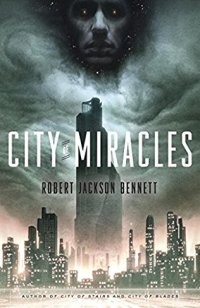
city-of-miraclesTitle: City of Miracles (2017)
Author: Robert Jackson Bennett
Pages: 448
Series:
The Divine Cities #3 (Series Tracker)
My thanks to NetGalley and the publisher for an advanced reader copy in exchange for an honest review.


In this final volume of Robert Jackson Bennett’s brilliantly inventive Divine Cities trilogy, the focus shifts to Sigrud je Harkvaldsson — for my money, one of the best characters in the series. Seeing him get the spotlight was a welcome sight, but I didn’t end up enjoying his POV as much as Shara’s and Mulaghesh’s before him. He may be better served as a supporting character being peppered-in sparingly rather than having full star-status, but as the plot unfolds you come to realize that he was the necessary choice for this role. While he struggles to carry parts of the novel, Bennett builds up a strong supporting cast around him that mostly negates this deficiency.

Bennett’s writing is as strong as ever here, as the novel sets off with a propulsive pace. I’ll set the scene — against the backdrop of a gloomy metropolis, a hulking, lone-wolf vigilante, stealthily picks off baddies one by one in the dark, fueled by the deaths of those he loved. He’s basically Batman for the first part of the novel and I loved it. Despite a middle portion that could have been tightened up as my interest started to wane, Bennett ratchets everything back up for the big heart-pounding finale that each of his books have done so well.

Overall, this was a worthy addition to the Divine Cities series, but not my favorite. That said, Robert Jackson Bennett nailed this trilogy and did a wonderful job with the interplay of gods & mortals, modernity & traditional fantasy worlds, and great characters & an imaginative story. I look forward to seeing what he puts out next.

★★★¾ out of 5

Review: Royal Assassin

68487Title: Royal Assassin (1996)
Author: Robin Hobb
Pages: 752
Series: Farseer Trilogy #2, Realms of the Elderlings #2 (Series Tracker)

The mindless Forged ones gain in number, roaming the Six Duchies like a zombie horde. Within Buckkeep, FitzChivalry Farseer hones his skills as a covert assassin and takes on a greater role in the kingdom, while thwarting plays for the throne from Prince Regal, his scheming uncle.

I have circled back to this series after three years away, having enjoyed the first book well enough, but never having a burning passion to continue beyond that. Dipping my toe into book two quickly brought me back to the world of the Six Duchies and brought me an enjoyment level I never quite found with Assassin’s Apprentice. I am not sure if the quality has improved tremendously from the first book to the next, or if I just have a firmer grasp on what strong fantasy writing looks like.  

Robin Hobb creates such a clear picture of human nature and emotion with her writing. It may be long-winded at times, but each scene, no matter how subtle, has a purpose (building characters, setting up a mystery, or unraveling one). I appreciate the time she takes with character development, as it makes me care more about each individual character. Relationships feel more meaningful, betrayals more devastating. The focus on one royal family line makes this possible, as stories like Game of Thrones have such massive casts that you can only really know each player and family in a limited sense.

I enjoyed Royal Assassin immensely and burned through it just wanting to know what would become of our dear protagonist. I deem my re-entry into the series a great success and am going to attempt to work my way through the remaining 15 books of Hobb’s Realm of the Elderlings series. Only ~10,000 pages to go until the new book is out in May!

★★★★½ out of 5
SPECULATIVE SHELF STARRED BOOK

Review: Amberlough

9780765383815Title: Amberlough (2017) – Preview Excerpt
Author: Lara Elena Donnelly

My thanks to NetGalley and the publisher for an advanced reader preview in exchange for an honest review.


This excerpt represents the first quarter of Amberlough and I’m unsure whether it piqued my interest enough to continue with the full novel. Amberlough City is a lush cityscape filled with rusting pipes, cigarettes, and sex. The setting is fascinating, but I never quite connected with the political narrative that drives the main story. Ultimately, I got the exact same amount of plot detail from the description on Goodreads that I did from this sample, so it is tough to judge how useful this excerpt is. The relationships are titillating and the characters unique, but I am not sure the story gripped me enough to see it through to the end. How cool is that cover, though?

★★★ out of 5

Review: Avempartha

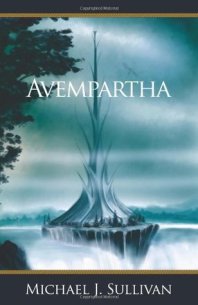
avemparthaTitle: Avempartha (2009)
Author: Michael J. Sullivan
Pages: 331
Series: The Riyria Revelations #2


Michael J. Sullivan’s books are fantasy comfort food  — likable characters, charming dialogue, clean plots, and unexpected twists all make for something infinitely enjoyable. Avempartha is no different. The second book of the Riyria Revelations series finds Hadrian and Royce, our intrepid rogues, tasked with breaking into yet another tower. This time they contend with a mythical flying reptile (not a dragon!) and the helpless villagers of a nearby town that have drawn the ire of the beast.

Despite hitting many of the same beats as the first novel, Avempartha charts some new territory — unforeseen information about the past of Hadrian and Royce is revealed, an unknown peasant girl rises to prominence, and the Church of Nyphron misuses their authority to further their (somewhat) noble aims.

I was disappointed that Myron, the naive monk from The Crown Conspiracy (see review), is nowhere to be found, but Esrahaddon, the 900-year-old wizard, is elevated into a supporting role, and his hidden maneuvering and prevarication makes him a compelling foil for Hadrian and Royce. The presence of princess Arista and peasant girl Thrace brings more visibility to the female characters of the world, but they are mostly used as the pawns of others and don’t have much of their own agency.

Sullivan has built a familiar, yet unique world that has deep mythical roots. Knowing that the lore is being fleshed out in his prequel series The Legends of the First Empire (see Age of Myth review) ensures that I don’t gloss over any passing mentions of the history of the world. I am more than happy to continue the Riyria journey in the present day and I look forward to moving on to Nyphron Rising.

★★★★ out of 5