
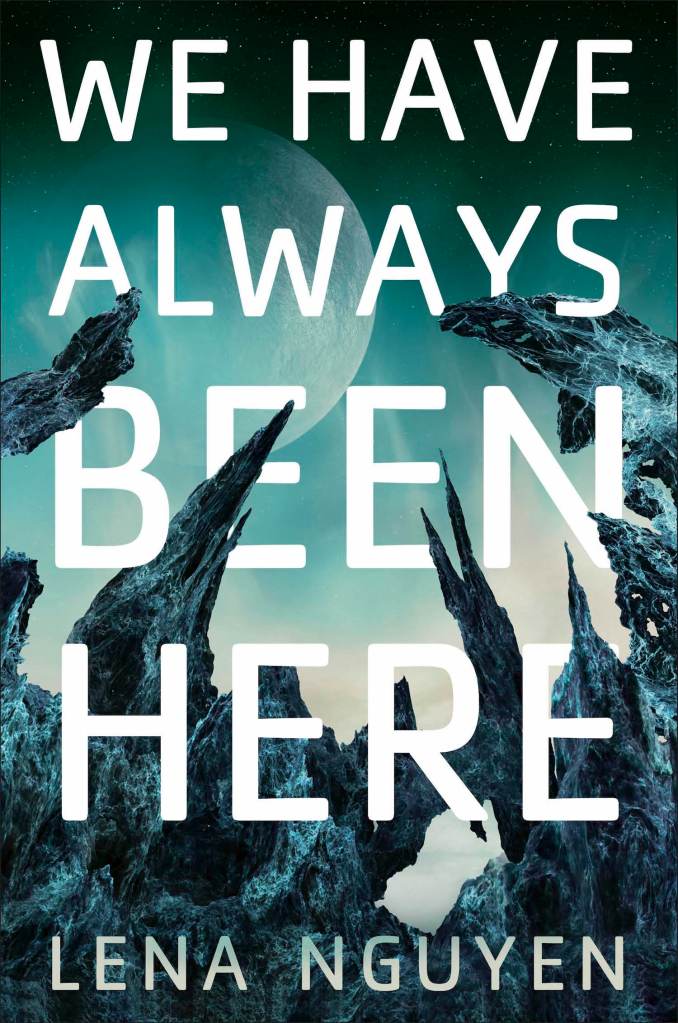
The Speculative Shelf is very excited to welcome Lena Nguyen to the blog today to discuss her excellent debut novel, We Have Always Been Here (out July 6, 2021) from DAW Books.
You can find our review of the book here.
Publisher’s summary: Misanthropic psychologist Dr. Grace Park is placed on the Deucalion, a survey ship headed to an icy planet in an unexplored galaxy. Her purpose is to observe the thirteen human crew members aboard the ship—all specialists in their own fields—as they assess the colonization potential of the planet, Eos. But frictions develop as Park befriends the androids of the ship, preferring their company over the baffling complexity of humans, while the rest of the crew treats them with suspicion and even outright hostility.
Shortly after landing, the crew finds themselves trapped on the ship by a radiation storm, with no means of communication or escape until it passes—and that’s when things begin to fall apart. Park’s patients are falling prey to waking nightmares of helpless, tongueless insanity. The androids are behaving strangely. There are no windows aboard the ship. Paranoia is closing in, and soon Park is forced to confront the fact that nothing—neither her crew, nor their mission, nor the mysterious Eos itself—is as it seems.
1. We Have Always Been Here is a tense psychological sci-fi thriller. I found your writing to really convey tension in a palpable way. Is there anything specific you focus on in your prose/word choice to evoke this feeling?
Thank you so much for your kind words, and thank you for having me for this interview!
Writing suspense and tense scenes has always been a balancing act for me. Typically, I tend to focus on making sentences very fluid and stream-of-consciousness, sort of scattered in subject, in order to replicate how fast the character’s thoughts must be moving in those heart-stopping moments. I also employ a lot of structural interruptions—such as sentences that are cut off in the middle of their train of thought by sudden action—as well as a lot of rapidfire internal questions. Park, the protagonist of We Have Always Been Here, has a habit of thinking about a million things at once in order to make sense of her situation, even as someone is chasing her down a hallway or menacing her with a gun; so the narration is peppered with a lot of How could this be happening? What about the security guard? Did the killer get him already, or—
That kind of rapid movement and pacing really helps ramp up and maintain the tension of the scene, I think—though you have to be careful to avoid getting so hectic and frenzied that readers lose track of what’s going on!
2. Your story jumps back and forth between Dr. Grace Park’s present and past, as well as a mysterious viewpoint told through video log transcriptions — how did you decide on this structure?
That’s a good question! Skirting spoilers as much as possible, I think playing around with space and time (and dreams and reality) is a large part of the book’s main conceit as well as a driving factor of its horror. The patients aboard the ship begin to have difficulty distinguishing between their waking states and nightmares. Park has difficulty making sense of the physical space of the ship; corridors seem to meld together, or turn into spaces that they shouldn’t, and you’re not really sure if this is due to her bad sense of direction or something else. Similarly, time begins to fold into itself in asymmetric ways: Park’s past and present (and future) become interconnected and hard to distinguish from each other, and you start to see in a very visceral way how her relationships with characters in the past are informing her relationships in the present: with her friends, android companions, adversaries, and even love interests. Eventually, past and present timelines get creased into the very same chapters or paragraphs as each other, instead of being clearly divided between “standalone” flashback chapters and present-day chapters—so the narrative structure of the book starts to reflect the overall progressive blending of space and time. I really wanted it to be this way from the start, partially to reflect what the characters themselves are experiencing on the ship, and partially because I knew that exploring Park’s past would be an important part of uncovering the mysteries that are plaguing the ship in the present.
As for the video transcripts, I’ve always been a big fan of the “found footage” genre of horror films. There’s an added layer to “found footage” in text and prose that really interests me—there’s something about the transcript format that leaves even more room for the imagination, subtext and space for the things unseen and unsaid. It allows you to fill in the gaps for yourself in a way that straightforward prose with an actual narrator doesn’t always allow. With a narrator, you have someone—even an omniscient, third-person observer—telling you what’s going on, laying out the scene for you, giving subtle shape to the narrative with their perspective and what they’re drawing your attention to. With “found footage” or the video transcripts, it’s more distanced, neutral: you are limited to what the “camera” records, what footage has survived, and you’re left to draw your own conclusions about what it’s all capturing (and not capturing). With the video transcripts in the book, you don’t initially know where or when all of this is taking place, who or what you’re embodying as the viewer, or the connection between when the videos were filmed versus when they were discovered versus when they were actually watched… It was another cool way to play around with space and time, alongside what was going on with Park!
3. Grace is one of two psychologists aboard the ill-fated Deucalion mission, which includes twelve other humans and a bevy of androids. What made you want to tap into Grace’s perspective?
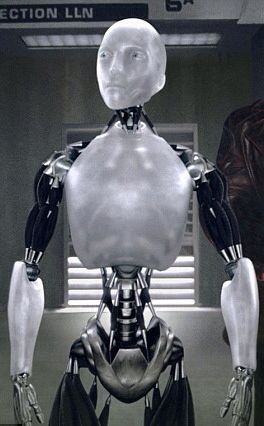
I feel like, in a lot of android media, we’re very preoccupied with the android characters’ journeys to becoming more human. We focus a lot on what happens to an android when it’s dropped into a human environment, how it adapts and learns and reacts to what’s going on around it. (Think Sonny in I, Robot.) And I was very interested in exploring the dynamic from the other way around: what happens to a person when their developmental stages are influenced very strongly by machine intelligences and android understandings of the world? How does that change them, alter the course of their personalities and even lives? Does it at all?
So the character of Park started with that question: what would a naturally introverted character be like if she was raised by androids? What would her thought process entail? I wanted to capture the comfort and security she might feel, surrounded by friends and family who are literally bound to never leave or conflict with her—but who still challenge her in certain ways, especially with their shortcomings. Vice-versa, I wanted to capture the alienation and skittishness she might feel about the unpredictability of human relationships and interactions, as opposed to the stability and safety of her android companions.
Her occupation as the ship’s psychologist stemmed from all of that. I feel that, in many ways, Park’s upbringing has made her into an observer of human activity, an outsider looking in, and her career in human psychology has been part of her effort to overcome that barrier. You see that persisting in her job on the Deucalion, as she’s tasked with observing what the other crewmembers are doing, always watching but never fully participating or understanding. That’s the perspective I wanted to tap into. She wants badly to understand, it’s a psychologist’s job to understand, but because she was brought up in such a different way, she faces certain obstacles that, say, a combat specialist or a pilot wouldn’t. Much of this book is about understanding, and what Park herself can or can’t comprehend, and her role as the ship’s orbiter and psychologist reflects that.
4. There’s a cinematic quality to this story and I think a film adaptation should surely be in order! Is there a film or TV show out there, sci-fi or otherwise, that you could say, “If you like X, you’ll like WHABH”?
Haha, thank you so much! When I was writing the book, a lot of the scenes played out in my head like cinematic sequences from a movie, so it would be an honor to see the story adapted for the screen!

The primary films that influenced the atmosphere and tension of We Have Always Been Here were Alien; I, Robot; Ex Machina; and Event Horizon, which are pretty much all science fiction murder mysteries or space horror films in some way. I think if people enjoy the book, especially the thriller aspects of it, they’ll definitely like those movies. (I mentioned I, Robot before, but the character of Sonny was a big influence in how I wrote Jimex, so that deserves another mention.)
I also thought a lot about how Stanley Kubrick filmed The Shining as a way to envision the disorientating and sometimes accordioning architecture of the Deucalion, so readers might enjoy the otherworldly, spatial impossibilities and claustrophobia there. I also think films like Arrival and Annihilation have ushered in a very cool age of sci-fi aesthetics that readers of We Have Always Been Here might enjoy.
Finally, I’m a big video game player, so some SFF games made their way into my writing of the book. For fans of We Have Always Been Here, I’d recommend checking out Detroit: Become Human, Dead Space, and Mass Effect.
5. What was the last great book you read? What are you reading now? What is next on your to-read list?

I’m a huge lover of fantasy, so everything I’ve read in the last year or so has been fantasy. I recently read two series that had a huge impact on me: the first would be the Daevabad trilogy by S.A. Chakraborty, starting with The City of Brass. The second would be the Chronicles of the Bitch Queen by K.S. Villoso, which starts with The Wolf of Oren-Yaro. Both series feature fascinating, complex, and flawed heroines (a little like Park, though I admit Nahri and Talyien are more badass); very lovely supporting casts; and spell-binding worldbuilding influenced by the magic of real-world cultures (Islamic and Filipino, respectively). I’m in love with both!
I am eagerly awaiting the next book in the Fire Sacraments series by Robert VS Redick, this latest offering being called Sidewinders. Robert is one of my favorite fantasy authors of all time, and Sidewinders releases on the same day that We Have Always Been Here does! So I’m very much looking forward to that!
6. Can you share what you’re working on next? Have you left the WHABH universe for good?
Right now, I’m in the earliest draft stages of my next novel, an apocalyptic fantasy I’m calling The Land of Salt and Bone. I haven’t decided yet whether it’s actually something like speculative fantasy, science fantasy, dieselpunk, or something else entirely… Basically, it’s Mad Max crossed with X-Men. There are assassins, gunfights, car chases across an apocalyptic and sometimes radioactive desert, the ghostly ruins of an advanced civilization, and mutant superpowers with very fun quirks and costs. The story mainly follows two assassins: one who accidentally picks up a pair of mutant twins in her bid to escape her past, and the other is a mercenary hired to kill the first. It’s very flashy and action-packed—different from the claustrophobia and darkness of We Have Always Been Here, but you might see a few subtle nods to characters from the Deucalion if you squint.
I always planned on We Have Always Been Here being a standalone story, but I know by now that you can never say never. As an undergrad, I wrote a novel set during the period of the Comeback—some hundred years before Park’s era in We Have Always Been Here—that I may revisit someday: that one’s about the plant armageddon and carbon pirates, both of which are mentioned in WHABH. So I might get back to that someday, or even visit other places in that universe, or even take a look at the Deucalion itself…
For now, though, I’m satisfied with how the pieces fell in Park’s story, and I think I hear the desert—both my home and The Land of Salt and Bone—calling my name.
Many thanks to Lena for her thoughtful, in-depth responses.
 The Speculative Shelf